
Quick facts
- Asset owner: FRV
- Client: Canadian Solar
- Location: Terang, VIC
- Project scale: 100MW / 200MWh
- Network: AusNet Services
- Funding: $7 million Victorian Government Energy Innovation Fund (EIF) grant (Round 2) targeted at enabling grid-forming inverter deployment
- Development scope led by TEC-C: Grid connection approval update (AEMO 5.3.9) and planning compliance update aligned to the final equipment configuration
The challenge
Terang is located in Southwest Victoria, a renewable-heavy corridor where parts of the network operate with lower system strength due to long electrical distances and high renewable penetration. In this environment, deploying a large standalone battery required more than conventional “grid-following” assumptions, it required proving grid-forming performance and satisfying AEMO’s evolving requirements around system strength, stability and modelling evidence.
The project also faced a common but material development risk. Earlier grid approvals were based on an inverter model that was later discontinued. By the time the project progressed to investment decision stage, the original grid connection assumptions needed to be updated to reflect the available inverter technology and preserve programme certainty.
1) Grid connection approval update (AEMO 5.3.9 / grid-forming)
Terang had previously achieved important grid connection milestones, including a 5.3.4A letter and Generator Performance Standards (GPS), however the approvals were tied to an inverter model available at the time the original grid modelling was performed. Once that inverter model was discontinued, the project required a formal update to the grid connection application and modelling pathway to maintain technical validity and investment readiness.
TEC-C, on behalf of FRV, was engaged by Canadian Solar to lead this update through the AEMO 5.3.9 process. The objective was not a simple substitution. The Victorian Government’s $7 million EIF grant was targeted specifically at de-risking the deployment of grid-forming inverters in a weaker part of the Victorian grid, meaning the modelling and approval pathway needed to address grid-forming behaviour rather than conventional grid-following assumptions.
TEC-C coordinated the technical evidence pathway and stakeholder interfaces required for approval, aligning modelling outputs and assumptions management with AEMO’s requirements and the AusNet network context. This work unlocked the grant-backed value of grid-forming capability and protected programme certainty by reducing approval-driven rework risk later in delivery.
2) DA / planning compliance update
Alongside connection approvals, Terang required practical alignment between the planning approval position and the equipment that would ultimately be delivered. In battery projects, early-stage proponents often lock in an inverter supplier and model early to progress grid connection studies, while the BESS container solution may initially be selected as a placeholder. When a final asset owner selects a different BESS container supplier, physical layout, cabling configuration and equipment arrangement can change, triggering Development Application update requirements.
TEC-C managed the planning compliance update pathway to align the DA position with the final project configuration. This reduced the risk of late-stage redesign and re-approval during construction, strengthened constructability and access planning, and improved schedule confidence through delivery and commissioning.
Impact
Terang BESS was positioned as a flagship grid-forming project in Victoria by combining a 100MW/200MWh (2-hour) battery with a grid connection approvals pathway designed to deliver stability services in a weak section of the grid. By leading the AEMO 5.3.9 update and aligning planning compliance with the final configuration, TEC-C removed key development hurdles and enabled a clearer pathway to timely delivery and reliable commissioning.
EPC Case Study
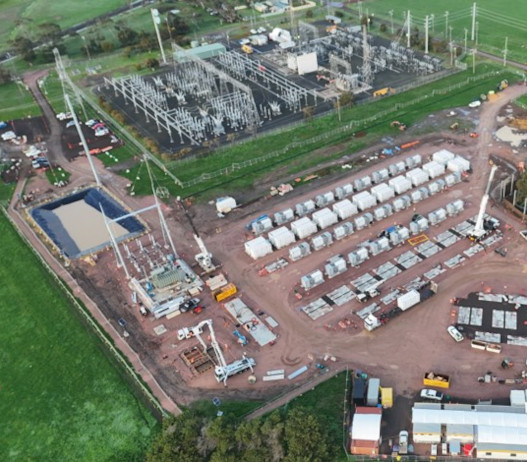
Key features:
- Led the AEMO 5.3.9 grid connection update required to replace a discontinued inverter model and preserve the project’s approvals pathway
- Delivered the technical approval pathway for grid-forming inverter operation, aligned to the EIF grant intent and network context
- Coordinated stakeholder interfaces and modelling evidence requirements to reduce approval-driven schedule risk
- Progressed DA / planning compliance updates required to align early approvals with the final equipment configuration
- Improved constructability and delivery certainty by reducing the likelihood of late-stage rework and re-approvals